
The Loophole That Is Breaking Debt Markets
Written by Eli Feldman
Imagine you loan a friend money. To protect yourself, you both sign a contract stating that if he cannot repay you, he will hand over his car. Now imagine that your friend and two other lenders secretly rewrite the contract so that those two other lenders get the car first, and you get nothing. Your friend did not miss a payment. He did not go to court. A majority of the group simply voted to change the rules, and suddenly your security is gone. This is not a hypothetical. It is happening right now in corporate debt markets, and it is legal.
This practice is called 'uptiering' or 'priming,' and it has become a favored tactic for struggling companies trying to buy more time. The LSTA (Loan Syndication and Trading Association), the primary body governing the syndicated loan market, must act now to broaden the definition of 'Sacred Rights,' which are contractual protections that require unanimous lender consent, to include any transaction that strips collateral from existing lenders without their approval. Courts, too, must apply a stricter standard. The Implied Covenant of Good Faith and Fair Dealing, a bedrock principle of contract law, is being systematically violated, and neither regulators nor judges have moved forcefully enough to stop it.
What Is a 'Capital Stack' and Why Does It Matter?
To understand why this is such a serious problem, you need to understand how corporate debt is structured. When a company borrows money, not all lenders are equal. They are arranged in what finance professionals call a 'capital stack,' a hierarchy that determines who gets paid back first if the company runs into trouble. Think of it like a building. Top-floor lenders are the safest; in a fire (a bankruptcy), they get out first. Lower-floor lenders face much more risk.
The table below shows how the capital stack works and what a priming transaction does to it:
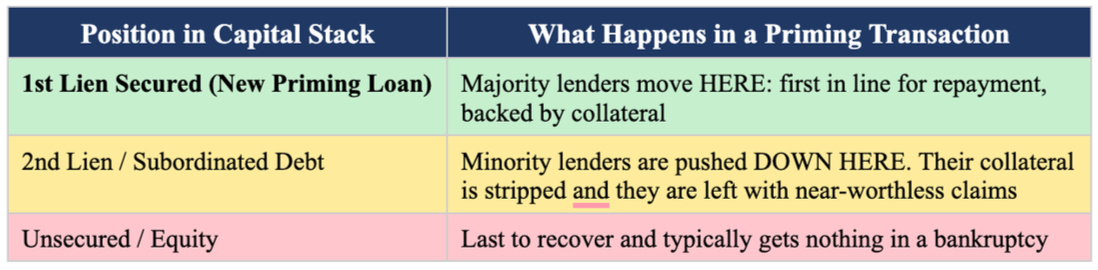
A 'priming' transaction works by getting a majority of lenders to agree to a new loan that sits at the very top of this hierarchy. The collateral, which refers to the assets that originally backed the existing loans, is now pledged to this new loan first. The lenders who did not participate are shoved down the stack without their consent. Their original contracts said they were first-lien secured. After the transaction, they are anything but.
The Rise of a New Playbook
This is not a niche legal argument. According to Octus Intelligence, the research firm formerly known as Reorg, liability management transactions in the leveraged loan market more than doubled in volume between 2022 and 2024, as companies struggled with higher interest rates and 'covenant-lite' loan structures, which are loans that stripped out many of the traditional protections that once gave lenders early warning when a borrower was in trouble. The rise of covenant-lite lending, which accelerated through the 2010s as investors chased yield in a low-rate environment, left creditors exposed. When rates rose sharply starting in 2022 and distressed borrowers began looking for creative solutions, the uptiering playbook was already sitting on the shelf.
The cases of Serta Simmons Bedding (2020) and Boardriders (2020) are the clearest examples. In both situations, the company reached private deals with a subset of its existing lenders, specifically those willing to participate in the new priming transaction. The remaining lenders, often smaller funds or those simply unwilling to participate on the company's terms, woke up to find their collateral pledged to someone else. The legal outcomes, however, diverged. In Boardriders, the New York Supreme Court denied a motion to dismiss in 2022, allowing minority lenders' breach of contract and good faith claims to proceed, and the case ultimately settled on terms favorable to those lenders. In Serta, the bankruptcy court initially blessed the transaction, but the Fifth Circuit reversed that decision on December 31, 2024, holding that the uptier violated the credit agreement's sacred right to ratable treatment. The fact that it took a federal appeals court four years to reach that conclusion illustrates precisely the problem: markets cannot function well when the same transaction is simultaneously legal in one court and a contract violation in another.
This Is Not Just 'Mean.' It Is a Breach of Contract
Critics of reforming this area of law often argue that sophisticated lenders should have negotiated better protections upfront. That argument has surface appeal but misses the point entirely. Loan agreements already contain so-called 'Sacred Rights' provisions, which are clauses that list changes requiring the consent of every single lender, not just a majority. These typically include changes to the interest rate, the maturity date, and the principal amount. The problem is that the definition of Sacred Rights has not kept pace with the creativity of restructuring advisors. Stripping collateral, it turns out, was not explicitly listed in most older agreements as requiring unanimous consent.
This is where the Implied Covenant of Good Faith and Fair Dealing becomes critical. This covenant is implied by law into every contract in the United States. It holds, in simple terms, that parties to a contract cannot take actions that, while technically permitted by the contract's literal language, effectively destroy the other party's benefit from that contract. When a majority of lenders use a loophole to take the collateral that minority lenders bargained for and paid a lower interest rate in exchange for accepting, that is not clever contract interpretation. It is a violation of the basic premise that contracts mean what they say.
Courts have been reluctant to apply this principle aggressively in the commercial lending context, deferring instead to the idea that sophisticated parties should fend for themselves. But that deference has a cost.
The Real Victim Is the Credit Market Itself
When lenders cannot trust that their contracts will be honored, they price in that risk. They demand higher interest rates. They require more restrictive covenants. They lend less. This does not just hurt the lenders who get 'primed' in a given transaction. It raises borrowing costs for every company that goes to the debt markets. According to PitchBook LCD, liability management exercises accounted for 69% of all restructuring activity by count in 2024, outpacing traditional payment defaults and bankruptcies in every single month of the year. The companies that suffer most are not the large, investment-grade borrowers with direct access to bond markets. They are mid-sized businesses that rely on syndicated bank loans and already operate on thinner margins.
There is a reason that the enforceability of contracts is considered foundational to a functioning market economy. Capital flows to where it is treated predictably. If the rules of lending can be rewritten by 51% of a creditor group to disadvantage the other 49%, the rules are not rules at all. They are suggestions. Sophisticated investors do not lend billions of dollars based on suggestions.
What Needs to Change
The LSTA should update its standard credit agreement templates to explicitly include any transaction that re-orders lender priority or strips collateral from existing lenders in the list of actions requiring unanimous consent. This is the most direct fix. The LSTA's templates are widely used across the syndicated loan market, so even a non-binding model change would rapidly shift market practice as borrowers and lenders incorporate the new language into new deals.
Courts, for their part, should apply the Implied Covenant of Good Faith and Fair Dealing more rigorously in cases where a majority of lenders have effectively destroyed the economic bargain of the minority. The argument that 'the contract permitted it' should not be sufficient when the action taken strips the core security interest that the minority lender specifically negotiated for and priced into its loan.
These are not radical proposals. They do not ban distressed exchanges or restructurings. Companies in trouble still need ways to address their debt loads, and lenders willing to provide new capital deserve to be compensated for the additional risk they are taking. The reform being proposed here is narrower: you cannot use a majority vote to take away what the minority was promised when they signed the original contract. That is not restructuring. That is redistribution by rule change.
Conclusion
The uptiering loophole is not just a problem for the hedge funds and institutional investors who end up on the wrong side of these transactions. It is a problem for the integrity of credit markets that millions of businesses and workers depend on. The LSTA must update its model documents, and courts must apply the Implied Covenant of Good Faith and Fair Dealing as the meaningful protection it was designed to be. Sacred Rights should mean exactly what the name implies: rights that a majority cannot simply vote away. Until that standard is enforced, every loan agreement in the United States is a little less certain, and every borrower will pay for that uncertainty in the form of higher costs and tighter credit.
Sources
Cleary Gottlieb Steen & Hamilton LLP. "New York State Supreme Court Allows Claims by Minority Lenders Not Participating in Uptier Debt Exchange to Survive Motion to Dismiss." November 2, 2022. https://www.clearygottlieb.com/news-and-insights/publication-listing/new-york-state-supreme-court-allows-claims-by-minority-lenders-not-participating-in-uptier-debt-exchange-to-survive-motion-to-dismiss
Excluded Lenders v. Serta Simmons Bedding, L.L.C., No. 23-20181 (5th Cir. Dec. 31, 2024). CourtListener
ICG Global Loan Fund 1 DAC v. Boardriders, Inc., No. 655175/2020 (N.Y. Sup. Ct. Oct. 17, 2022).
Kakouris, Rachelle. "Leveraged Loan Payment Default Rate Falls as Companies Lean In to LMEs." PitchBook LCD, January 3, 2025. https://pitchbook.com/news/articles/leveraged-loan-payment-default-rate-falls-as-companies-lean-in-to-lmes
MarketWatch. "Bond Investors Are Worried About the Fiscal Situation in the U.S." Photo illustration. MarketWatch/iStockphoto. https://www.marketwatch.com/story/whats-at-stake-if-worlds-most-powerful-market-finally-buckles-after-decades-long-u-s-debt-splurge-35de1617
Octus Intelligence (formerly Reorg). "The Year in Liability Management Exercises: Uptiers, Dropdowns, and Lessons from 2024." April 7, 2025. https://octus.com/resources/blog/the-year-in-liability-management-exercises-lmes/
O'Melveny & Myers LLP. "Priming Transactions Update: Boardriders." 2022. https://www.omm.com/insights/alerts-publications/priming-transactions-update-boardriders/
